
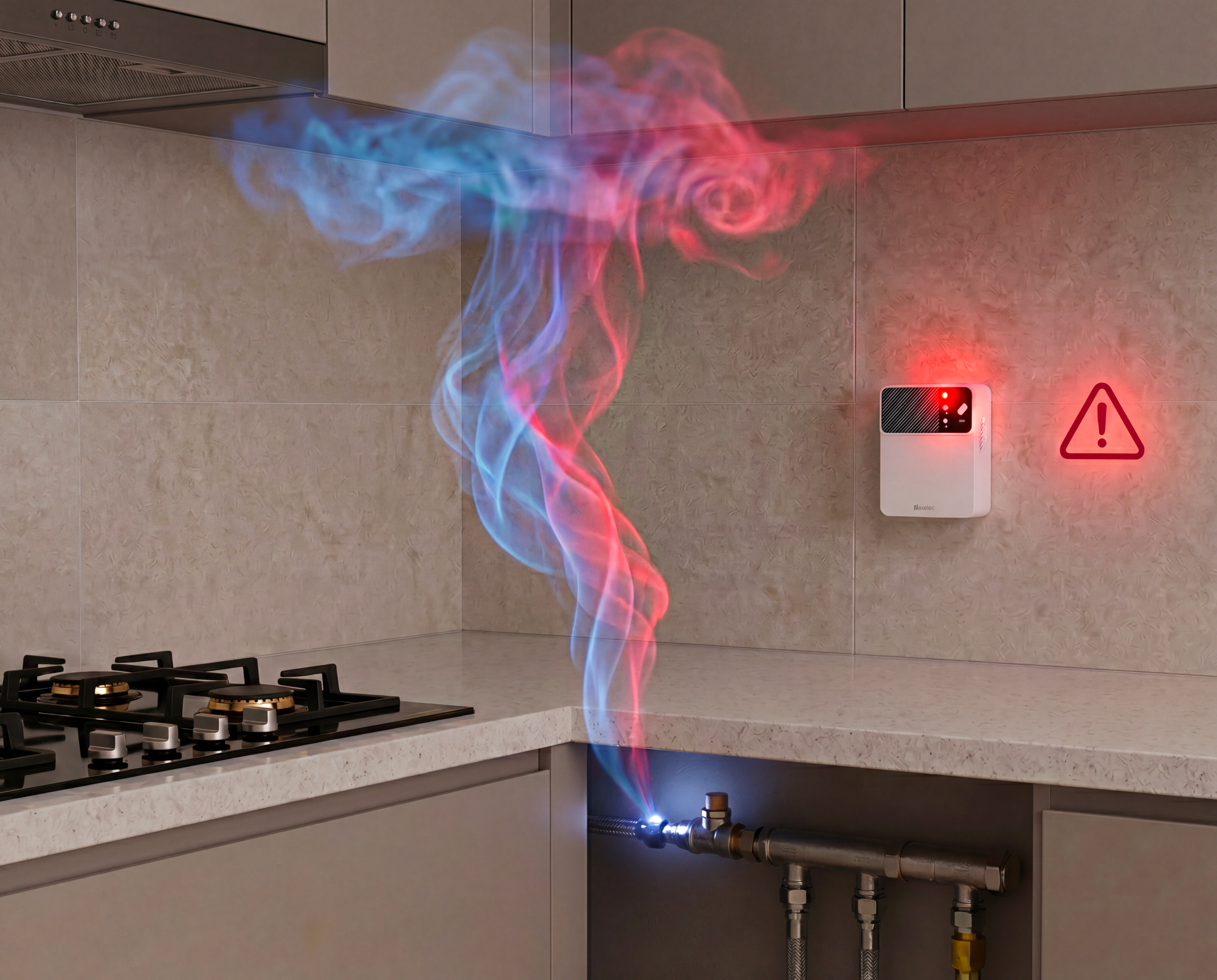
VIGAS is a battery-powered residential natural gas alarm manufactured by NEXELEC. It continuously monitors for natural gas, primarily methane, and provides an audible and visual warning when the concentration reaches 10% of the Lower Explosive Limit (LEL).
VIGAS is ETL Listed by Intertek and conforms to UL 1484. Its sealed lithium battery is designed for a 10-year service life, with no electrical outlet, wiring or routine battery replacement required.


Published on 10 August 2026
VIGAS Natural Gas Alarm and NYC Local Law 157: A Guide for Property Owners
In this article:
For New York City property owners, these characteristics are particularly relevant because NYC Local Law 157 requires natural gas detection in covered residential properties. The New York City Department of Buildings confirmed on June 15, 2026 that required natural gas alarms must be installed on or before January 1, 2027, and that the deadline will not be extended beyond that date.
Choosing a listed natural gas alarm is only one part of compliance. Building classification, gas appliance location, alarm placement, power-source requirements, installation, resident information and record keeping must also be considered.
Last reviewed: August 10, 2026
Primary regulatory sources: NYC Department of Buildings Natural Gas Detection Devices FAQs, 1 RCNY §908-02 and the NYC DOB June 15, 2026 Service Notice.
VIGAS product sources: VIGAS product page and VIGAS Datasheet.
What is VIGAS?
VIGAS is a standalone natural gas alarm designed for indoor residential environments. It detects natural gas, primarily methane, rather than smoke or carbon monoxide.
When methane reaches the alarm threshold, VIGAS provides both audible and visual warnings. Its alarm threshold is 10% LEL, meaning the alarm is designed to provide warning before the concentration reaches the Lower Explosive Limit at which an ignitable methane-air mixture can form.
VIGAS is powered by an integrated sealed lithium battery designed to operate throughout the alarm’s 10-year service life. It does not require an electrical receptacle or electrical wiring.
This configuration can be particularly useful when property teams need to deploy natural gas alarms across existing apartment buildings and residential portfolios where electrical work would add installation complexity.
For complete product specifications, see the VIGAS Natural Gas Alarm product page or review the official VIGAS Datasheet.
VIGAS at a glance
| Characteristic | VIGAS |
|---|---|
| Product type | Residential natural gas alarm |
| Manufacturer | NEXELEC |
| Reference | K987GL |
| Gas detected | Natural gas, primarily methane |
| Alarm threshold | 10% LEL |
| Audible alarm | 85 dB at 10 ft |
| Alert | Audible and visual |
| Power source | Sealed lithium battery |
| Designed service life | 10 years |
| Electrical outlet required | No |
| Wiring required | No |
| Certification | ETL Listed by Intertek |
| Standard | Conforms to UL 1484 |
| Environment | Indoor residential use |
| Device identification | QR code |
| Fleet management | NAVIXIS |
VIGAS does not detect carbon monoxide, smoke or propane. Separate or appropriately listed combination devices must be selected where protection against those hazards is required.
What does NYC Local Law 157 require?
NYC Local Law 157 established natural gas detection requirements for covered residential buildings in New York City.
Local Law 102 of 2025 subsequently changed the installation deadline to January 1, 2027. The law provided for a possible extension to January 1, 2029 if the Department of Buildings could not identify at least four distinct manufacturers of qualifying battery-powered natural gas alarms.
That condition has now been resolved.
On June 15, 2026, the New York City Department of Buildings announced that it had identified at least four distinct manufacturers of battery-powered natural gas alarms. The Department therefore confirmed that the installation deadline will not be extended beyond January 1, 2027.
Property owners should now plan around January 1, 2027 as the applicable deadline.
Official source: NYC Department of Buildings — Deadline to Install Natural Gas Alarms is January 1, 2027.
For a broader regulatory overview, read our NYC Local Law 157 Natural Gas Alarm Requirements guide.
Which residential buildings are covered?
DOB Rule 1 RCNY §908-02 addresses private dwellings, Class A multiple dwellings and Class B multiple dwellings as defined in the Housing Maintenance Code.
The rule does not apply to buildings that do not have gas piping or gas service.
The precise requirements can depend on the property and the location of fuel-gas-burning appliances.
For example, Class B multiple dwellings may under certain conditions use a line-operated zoned natural gas detecting system in public corridors and public spaces instead of standalone natural gas alarms in every dwelling.
However, DOB guidance states that where a gas appliance is located inside a dwelling, a natural gas alarm must still be installed in that dwelling.
Property owners should therefore review their portfolio building by building, dwelling by dwelling and appliance by appliance rather than assuming that one deployment strategy applies to every property.
Read our detailed guide on who must comply with NYC Local Law 157.
Is VIGAS suitable for NYC Local Law 157 projects?
VIGAS is ETL Listed by Intertek and conforms to UL 1484 for residential natural gas alarm applications.
This is relevant because the NYC Department of Buildings Natural Gas Detection Devices FAQs state that applicable natural gas alarms must meet the relevant listing and labeling requirements, including UL 1484.
However, an alarm should not be described as automatically making an entire property “Local Law 157 compliant.”
Compliance can depend on:
- whether the property is covered by the requirement;
- building and occupancy classification;
- the location of fuel-gas-burning appliances;
- the number of alarms required;
- building completion date;
- applicable power-source requirements;
- correct installation and placement;
- manufacturer instructions;
- maintenance and replacement;
- resident information and notices; and
- applicable record-keeping obligations.
The NYC Department of Buildings also states that it does not endorse a specific manufacturer or model of natural gas alarm.
For that reason, the most accurate description is:
VIGAS is ETL Listed by Intertek and conforms to UL 1484. Its suitability for a specific NYC Local Law 157 installation must be evaluated together with the applicable building requirements, power-source requirements, installation location and manufacturer instructions.
This is more precise than describing VIGAS as simply “NYC approved.”
What about battery-powered natural gas alarms?
Power-source requirements deserve particular attention.
According to current DOB guidance, buildings issued a Temporary Certificate of Occupancy or Certificate of Occupancy before January 1, 2027 may use a monitored battery as a primary power source for fuel-gas warning equipment, subject to the applicable requirements.
Buildings completed after January 1, 2027 are subject to different primary and secondary power requirements.
Property teams should therefore verify the building completion date and applicable power-source requirements before selecting equipment for a project.
Where should VIGAS be installed in a New York City dwelling?
Correct placement is a critical part of natural gas detection.
Under 1 RCNY §908-02, where a fuel-gas-burning appliance is installed within a dwelling, the natural gas alarm must generally be installed in the same room as the appliance.
The alarm must generally be:
- at least 3 feet from the fuel-gas-burning appliance;
- no more than 10 feet from the appliance; and
- measured horizontally.
The rule allows applicable natural gas alarms to be installed on the ceiling or wall.
When installed on a wall, the alarm must generally be located not more than 12 inches from the ceiling.
There is an important exception. Where the existing space does not allow installation at least 3 feet from the fuel-gas-burning appliance, or where manufacturer instructions or applicable NFPA 715 provisions require a different location, the installation must follow those applicable location requirements.
For VIGAS specifically, the current product specifications describe the device as wall-mounted. Installers should always follow the current manufacturer instructions supplied with the product when selecting the final mounting location.
For more detail, see our guide to natural gas alarm placement in NYC.
Example: apartment with a natural gas range
For an apartment kitchen containing a natural gas range, the installation review should confirm:
- that the alarm is located in the same room as the range;
- that the horizontal distance from the appliance is evaluated against the applicable 3-to-10-foot rule;
- that the wall mounting position is appropriate;
- that the manufacturer installation requirements have been reviewed; and
- that the device and installation location are properly recorded.
Do not assume that the location used for a carbon monoxide or smoke alarm is automatically appropriate for a natural gas alarm.
Example VIGAS placement near a natural gas range
[EDITOR NOTE — INSERT ORIGINAL NEXELEC VIGAS INSTALLATION DIAGRAM HERE, THEN REMOVE THIS LINE.]
Illustrative NYC placement example. Under 1 RCNY §908-02, where a fuel-gas-burning appliance is installed within a dwelling, the natural gas alarm must generally be installed in the same room, at least 3 feet but not more than 10 feet from the appliance, measured horizontally. Where installed on a wall, the alarm must generally be located not more than 12 inches from the ceiling. Manufacturer instructions and applicable NFPA 715 requirements may require a different location.
Official source: 1 RCNY §908-02 — Standards for Installation and Location of Natural Gas Alarms.
Common VIGAS installation mistakes to avoid
Property teams should avoid treating natural gas alarm placement as interchangeable with smoke or carbon monoxide alarm placement.
Common issues to check before installation include:
- Installing the alarm in a different room from the fuel-gas-burning appliance.
- Installing the alarm less than 3 feet or more than 10 feet horizontally from the appliance without confirming that an applicable exception or manufacturer requirement applies.
- Selecting a wall position without checking the applicable maximum distance from the ceiling.
- Determining the location without reviewing the current manufacturer instructions.
- Recording only the apartment number without recording the room and device identifier.
- Installing alarms before establishing a consistent portfolio-wide record-keeping process.
- Assuming that product certification alone makes the complete property compliant with Local Law 157.
A good installation process combines NYC requirements, manufacturer instructions and accurate property records before the device is placed on the wall.
Who can install a battery-powered natural gas alarm in NYC?
NYC rules distinguish between electrically connected equipment and battery-powered or plug-in alarms.
Under 1 RCNY §908-02, natural gas alarms generally must be installed by a New York City Licensed Electrical Contractor who obtains the required permits.
However, the rule provides an exception for natural gas alarms powered by battery or plug-in AC receptacle.
According to the NYC DOB Natural Gas Detection Devices FAQs, these alarms may be installed by someone other than a licensed electrical contractor, including:
- the building owner;
- building maintenance personnel;
- the dwelling unit occupant; or
- another installer.
Because VIGAS uses a sealed battery and requires no electrical wiring or outlet, physical installation does not require the electrical work associated with a hardwired alarm.
Property owners must still confirm that the selected alarm, power configuration, building and installation are appropriate for the project.
Why consider VIGAS for multifamily and managed residential properties?
Equipping one apartment is very different from managing hundreds or thousands of alarms across a residential portfolio.
For property managers, operational questions quickly become important:
- Which building contains each device?
- Which apartment is it installed in?
- Which room?
- Which gas appliance is associated with the installation?
- When was the alarm installed?
- What is its product reference?
- What is its device identifier?
- When will it reach the end of its useful life?
- Has the device been tested or replaced?
- Which dwelling units are still awaiting installation?
VIGAS addresses part of this operational challenge through its sealed power source, QR code and digital fleet-management approach.
10-year sealed battery
The integrated lithium battery is designed for the alarm’s 10-year service life.
Under normal operating conditions, routine battery replacement is not required during that service life.
This can reduce battery-related maintenance operations across large housing portfolios.
QR-based identification
Each VIGAS detector can be identified using its QR code, helping property teams associate a physical alarm with installation and maintenance records.
NAVIXIS digital logbook
NEXELEC’s NAVIXIS platform can support the organization of detector information across a fleet.
This can help teams associate field information such as device identity, installation location and maintenance data with individual alarms.
Digital tracking does not replace an owner’s regulatory responsibilities, but a structured inventory can make those responsibilities easier to manage across multiple properties.
What should property managers record during a VIGAS deployment?
A portfolio deployment should create a reliable record for every installed alarm.
A practical installation record can include:
| Field | Example |
| Building | Property address |
| Unit | Apartment 4B |
| Room | Kitchen |
| Gas appliance | Natural gas range |
| Product | VIGAS |
| Reference | K987GL |
| Device ID / QR | Unique device identifier |
| Installation date | MM/DD/YYYY |
| Installation position | Recorded location |
| Installer | Owner / maintenance / contractor |
| Expected replacement | Based on product useful life |
| Test status | Passed |
| Resident information provided | Yes / No |
The NYC HPD detector guidance identifies record-keeping items that include the installation date and the expiration date of the manufacturer’s suggested useful life for applicable natural gas detecting devices.
A structured inventory should therefore be planned before a large deployment begins, rather than reconstructed after hundreds of devices have already been installed.
VIGAS Property Manager Installation Checklist
The following checklist can be used as an operational starting point when preparing a multi-unit VIGAS deployment.
Before entering the dwelling
- ☐ Confirm that the property and dwelling are within the planned deployment scope.
- ☐ Identify the dwelling unit.
- ☐ Identify each fuel-gas-burning appliance in the dwelling.
- ☐ Identify the room containing each applicable appliance.
- ☐ Review the planned alarm location.
- ☐ Confirm the applicable NYC requirements.
- ☐ Review the current VIGAS manufacturer instructions.
During installation
- ☐ Confirm that the alarm is being installed in the appropriate room.
- ☐ Verify the horizontal distance from the fuel-gas-burning appliance.
- ☐ Confirm the permitted mounting position.
- ☐ Record the VIGAS product reference.
- ☐ Record the VIGAS device ID / QR code.
- ☐ Record the exact room and installation location.
- ☐ Record the installation date.
- ☐ Test the alarm according to the manufacturer instructions.
After installation
- ☐ Associate the device with the correct building and dwelling record.
- ☐ Record the expected end-of-life or replacement date.
- ☐ Record the installation and test status.
- ☐ Provide applicable resident information and notices.
- ☐ Store the installation record.
- ☐ Add the device to the property’s maintenance and replacement process.
For a large portfolio, use the same record structure across every building so information remains consistent from the first installation to the last.
VIGAS natural gas alarm vs. carbon monoxide alarm
A natural gas alarm and a carbon monoxide alarm detect different hazards.
| Natural Gas Alarm | Carbon Monoxide Alarm |
| Detects leaking fuel gas | Detects carbon monoxide |
| VIGAS primarily detects methane | CO is created by incomplete combustion |
| Addresses the risk associated with accumulating natural gas | Addresses toxic CO exposure |
| Installed according to natural gas alarm requirements | Installed according to CO alarm requirements |
| Does not automatically replace a CO alarm | Does not automatically detect natural gas |
A standard carbon monoxide detector should therefore not be treated as a substitute for a natural gas alarm.
Likewise, VIGAS is not a smoke or carbon monoxide alarm.
A property may require multiple types of life-safety devices depending on its equipment, occupancy and applicable regulations.
For a detailed comparison, read Natural Gas Alarm vs. Carbon Monoxide Alarm: What Property Managers Need to Know.
How should a property manager evaluate VIGAS before a large deployment?
Before placing a portfolio-wide order, start with a property survey.
The assessment should identify:
- every property potentially covered by Local Law 157;
- the building and occupancy classification;
- building completion or Certificate of Occupancy information where relevant;
- whether gas piping or gas service exists;
- the location of fuel-gas-burning appliances;
- the number of dwelling units affected;
- the number and placement of alarms potentially required;
- applicable power-source requirements;
- resident access requirements;
- documentation and notice requirements; and
- the process for tracking installed devices over time.
Then compare those requirements with the product documentation.
For VIGAS, relevant characteristics include residential methane detection, a 10% LEL alarm threshold, ETL listing by Intertek, conformity to UL 1484, a sealed 10-year lithium battery, audible and visual warnings and QR-based digital identification.
This assessment matters because the number of apartments does not necessarily equal the final number of alarms required. Appliance locations, dwelling configuration, building classification and power requirements can affect the deployment strategy.
For deadline information, see Local Law 157 Deadline Confirmed: Natural Gas Alarms Are Due January 1, 2027.
Example VIGAS deployment workflow for a multifamily property
A portfolio-wide VIGAS deployment can be organized into six operational phases.
1. Property survey
Identify covered buildings, dwelling units and rooms containing fuel-gas-burning appliances.
Record the information in a consistent survey format before scheduling installation.
2. Placement review
Determine the planned natural gas alarm location for each applicable appliance using NYC requirements and the current VIGAS manufacturer instructions.
Resolve unusual layouts or installation questions before field teams begin large-scale deployment.
3. Resident access planning
Organize access by property, floor, dwelling or installation zone.
A coordinated schedule can reduce repeat visits and help property teams identify inaccessible units that require follow-up.
4. Installation and testing
Install each VIGAS alarm in the planned location and test the device according to the manufacturer instructions.
Record any dwelling where the planned location had to be reassessed.
5. Device registration
For every installed VIGAS, record:
- property;
- dwelling;
- room;
- associated gas appliance;
- installation date;
- device reference;
- QR/device identifier;
- installer; and
- test status.
6. Lifecycle tracking
Maintain installation and replacement information so property teams can identify alarms approaching the end of their expected useful life.
For large portfolios, the workflow should be documented before field deployment begins so installation information remains consistent across teams, buildings and dwelling units.
Frequently Asked Questions about VIGAS and NYC Local Law 157
Does VIGAS need to be plugged into an electrical outlet?
No. VIGAS uses a sealed lithium battery and does not require an electrical outlet or electrical wiring.
The battery is designed to operate throughout the alarm’s 10-year service life under normal operating conditions.
What gas does VIGAS detect?
VIGAS detects natural gas, primarily methane.
It does not detect carbon monoxide, smoke or propane.
At what concentration does VIGAS sound an alarm?
VIGAS provides an audible and visual warning at 10% of the Lower Explosive Limit (LEL) for methane.
Ten percent LEL does not mean that the air contains 10% methane. It refers to one tenth of the concentration corresponding to the Lower Explosive Limit.
Is VIGAS UL 1484 certified?
VIGAS is ETL Listed by Intertek and conforms to UL 1484 for residential natural gas alarm applications.
This exact wording should be used when describing the product’s certification.
Is VIGAS approved by the New York City Department of Buildings?
The NYC Department of Buildings states that it does not endorse individual natural gas alarm manufacturers or models.
VIGAS is ETL Listed by Intertek and conforms to UL 1484. Whether a specific installation satisfies NYC requirements also depends on factors including the building, power source, alarm location, installation and applicable rules.
What is the NYC Local Law 157 deadline?
The installation deadline is January 1, 2027.
On June 15, 2026, the NYC Department of Buildings confirmed that it had identified at least four distinct manufacturers of battery-powered natural gas alarms. As a result, DOB confirmed that the installation date will not be extended beyond January 1, 2027.
Where should VIGAS be installed relative to a gas appliance?
For a covered NYC dwelling containing a fuel-gas-burning appliance, DOB rules generally require the natural gas alarm to be installed in the same room and at least 3 feet but not more than 10 feet from the appliance, measured horizontally.
Where a natural gas alarm is wall-mounted, the rule generally requires it to be located not more than 12 inches from the ceiling.
Manufacturer instructions and applicable exceptions must also be considered when selecting the final location.
Can building maintenance staff install VIGAS?
NYC DOB guidance states that natural gas alarms powered by battery or plug-in AC receptacle may be installed by someone other than a licensed electrical contractor, including the building owner, building maintenance personnel or the dwelling unit occupant.
Requirements differ for hardwired equipment.
Does VIGAS replace a carbon monoxide detector?
No.
VIGAS detects natural gas, primarily methane. A carbon monoxide alarm detects CO.
One device should not be assumed to replace the other unless a specifically listed combination product provides all required detection functions.
How long does VIGAS last?
VIGAS uses a sealed lithium battery designed to support a 10-year product service life under normal operating conditions.
The complete alarm should be replaced at the applicable end-of-life or replacement date according to the product instructions.
Official NYC sources for Local Law 157
Property owners and installation teams should use primary New York City sources when making compliance decisions.
NYC Department of Buildings — Natural Gas Detection Devices FAQs
Use this resource for current DOB guidance on affected occupancies, alarm placement, power sources, UL 1484 requirements and installer qualifications.
View the NYC DOB Natural Gas Detection Devices FAQs.
NYC Department of Buildings — June 15, 2026 Service Notice
Use this as the primary source for the confirmed January 1, 2027 deadline.
View the NYC DOB Service Notice.
1 RCNY §908-02 — Standards for Installation and Location of Natural Gas Alarms
Use this for the underlying NYC rule addressing installation, location, listing and installer qualifications.
1 RCNY §3616-06 — NFPA 715 amendments
Use this for NYC modifications to NFPA 715 and applicable fuel-gas warning equipment requirements.
Local Law 102 of 2025
Use this when reviewing the legislative change to the Local Law 157 implementation timeline.
NYC HPD — Smoke, Carbon Monoxide and Natural Gas Detectors
Use this resource for owner and tenant responsibilities, notices, replacement information and record keeping.
View NYC HPD detector guidance.
Deadline note: for the current deadline, use the June 15, 2026 Department of Buildings Service Notice as the primary source confirming that the installation date will not be extended beyond January 1, 2027.
Learn more about VIGAS
VIGAS provides continuous residential natural gas detection, primarily methane, with an audible and visual warning at 10% LEL, a sealed battery designed for a 10-year service life and QR-based identification to support property managers deploying alarms across multiple dwelling units.
Need technical specifications?
View the VIGAS Natural Gas Alarm.
Need the technical datasheet?
View the VIGAS Datasheet.
Need a broader overview of the NYC regulation?
Read the NYC Local Law 157 Natural Gas Alarm Requirements guide.
Need help determining who is covered?
Read Who Must Comply With NYC Local Law 157?.
Need detailed placement guidance?
Read Where to Install a Natural Gas Alarm in NYC.
Managing a multifamily property or residential portfolio in New York City?
Request a VIGAS quote or contact NEXELEC to discuss product availability and portfolio deployment.