
NYC Local Law 157 natural gas alarm requirements
Prepare your residential building for NYC Local Law 157 with VIGAS, NEXELEC’s battery-powered residential natural gas alarm. VIGAS is ETL Listed by Intertek and conforms to UL 1484. It detects natural gas, primarily methane, and is designed with a sealed 10-year lithium battery for residential environments and multi-unit property portfolios.
NYC Local Law 157 requires natural gas detection in covered residential buildings in New York City. The New York City Department of Buildings has confirmed that required natural gas alarms must be installed on or before January 1, 2027.
Building owners should use the remaining time to identify covered properties, review gas appliance locations, select appropriate natural gas alarms, plan installation, coordinate access to dwelling units, and organize installation and maintenance records.
Want to evaluate VIGAS for your NYC properties? Read our complete guide to VIGAS and NYC Local Law 157.

What is Local Law 157?
|
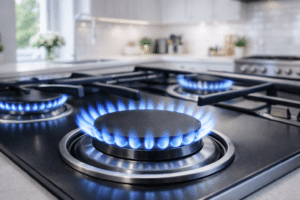
Local Law 157 is a New York City requirement related to natural gas detection in covered residential buildings. It was created to strengthen gas safety by requiring natural gas alarms or approved natural gas detecting systems in certain residential properties. For building owners and property managers, the law is not only about purchasing a device. It also involves choosing the right alarm, installing it in the proper location, maintaining the device, replacing it at the end of its useful life, and keeping the right records. Natural gas alarms are intended to provide early warning when natural gas is detected. This is different from carbon monoxide detection. A carbon monoxide alarm detects CO produced by incomplete combustion, while a natural gas alarm detects fuel gas before it is burned. |
 |
Confirmed Local Law 157 deadline: January 1, 2027
The deadline for the installation of required natural gas alarms under NYC Local Law 157 is January 1, 2027.
Local Law 102 of 2025 moved the previous compliance timeline to January 1, 2027 and provided for a possible extension to January 1, 2029 if the New York City Department of Buildings could not identify at least four distinct manufacturers of qualifying battery-powered natural gas alarms.
That condition has now been resolved.
On June 15, 2026, the New York City Department of Buildings announced that it had identified at least four distinct manufacturers of battery-powered natural gas alarms. As a result, DOB confirmed that the installation deadline will not be extended beyond January 1, 2027.
Property owners should therefore plan their Local Law 157 compliance programs around the January 1, 2027 deadline. For large residential portfolios, preparation should include reviewing covered buildings, identifying dwelling units with gas-burning appliances, selecting appropriate alarms, coordinating resident access, planning installation, and maintaining the required records.
Official source: New York City Department of Buildings — “Deadline to Install Natural Gas Alarms is January 1, 2027,” Service Notice, June 15, 2026.
For additional context on the deadline, see our Local Law 157 Deadline Confirmed: Natural Gas Alarms Are Due January 1, 2027.

Which buildings are covered?
Local Law 157 applies to covered residential buildings in New York City, including certain Class A multiple dwellings, Class B multiple dwellings, and private dwellings.
In general, property owners should evaluate buildings with natural gas piping, natural gas service, or gas-burning appliances. Buildings without natural gas piping or natural gas service may be treated differently, but owners should confirm applicability with NYC rules, the Department of Buildings, HPD guidance, and qualified professionals.
For property managers, the first step is to create a building inventory:
- Buildings with natural gas service
- Dwelling units with gas-burning appliances
- Mechanical rooms or spaces with gas equipment
- Fuel-gas points of entry
- Units or spaces where alarm placement must be reviewed
- Existing smoke and carbon monoxide alarm records
- Installation and replacement records that need to be updated
What type of natural gas alarm is required?
Property owners should verify that any natural gas alarm selected for a New York City property meets the applicable listing, labeling, power-source, installation, and building requirements.
According to the New York City Department of Buildings Natural Gas Detection Devices FAQs, applicable single-station and multiple-station natural gas alarms must meet the relevant listing and labeling requirements, including UL 1484 as applicable. Requirements may vary depending on the type of building, detection system, power source, and installation configuration.
VIGAS is ETL Listed by Intertek and conforms to UL 1484 for residential natural gas alarm applications. It detects natural gas, primarily methane, provides audible and visual alerts, and uses a sealed lithium battery designed for a 10-year service life. VIGAS also includes QR-based device identification to support installation and maintenance tracking across multi-unit properties.
Product certification alone does not determine compliance for an entire property. Building owners must also verify that the building is covered by the requirement, that the appropriate number of alarms is installed, and that each device is positioned according to applicable NYC requirements and manufacturer instructions.
For a detailed review of the product, certification, installation considerations and NYC requirements, read our VIGAS Natural Gas Alarm and NYC Local Law 157 guide.

Where must natural gas alarms be installed?
Natural gas alarm placement depends on the building type, appliance location, manufacturer instructions, and applicable NYC rules.
According to the NYC Department of Buildings Natural Gas Detection Devices FAQs, where a fuel-gas-burning appliance is installed within a dwelling, the natural gas alarm must generally be installed in the same room as the appliance.
The alarm must generally be located at least 3 feet but not more than 10 feet from the appliance, measured horizontally.
NYC requirements should always be considered together with the alarm manufacturer’s installation instructions. For VIGAS installations, property teams should review the current VIGAS installation documentation before determining the final mounting location.
For a more detailed explanation, see Where to Install a Natural Gas Alarm in NYC.
You can also review the underlying NYC rule 1 RCNY §908-02.
Why VIGAS for NYC residential buildings?
|
VIGAS is designed for residential natural gas detection and for deployment across both individual homes and multi-unit property portfolios. Key product characteristics include:
|
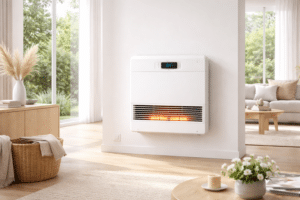 |
For property managers, a self-contained battery-powered alarm can simplify deployment across existing residential buildings by reducing electrical installation requirements. QR-based identification can also help teams organize installation, maintenance and replacement information across multiple units.
VIGAS does not by itself make a building compliant with Local Law 157. Compliance also depends on the building, the location and number of alarms, correct installation, applicable NYC requirements and manufacturer instructions.
Read our complete VIGAS and NYC Local Law 157 guide for product specifications, certification information, installation considerations and official NYC sources.
Local Law 157 compliance checklist for building owners
Before January 1, 2027, property owners and property management teams should establish a clear natural gas alarm deployment plan.
A practical Local Law 157 checklist includes:
- Identify properties potentially covered by the natural gas alarm requirements
- Confirm whether natural gas piping or natural gas service is present
- Identify dwelling units and spaces containing fuel-gas-burning appliances
- Confirm the applicable requirements for each building classification
- Determine the number of natural gas alarms required
- Verify applicable listing and labeling requirements
- Select an appropriate natural gas alarm
- Review manufacturer installation instructions
- Confirm alarm placement relative to each gas-burning appliance
- Plan access to dwelling units
- Record installation dates and device information
- Track each alarm’s useful life and replacement date
- Prepare required resident notices and safety information
- Establish procedures for testing, maintenance and replacement
- Train relevant property staff on what to do if a natural gas alarm sounds
For properties considering VIGAS, the product’s QR-based identification and NAVIXIS platform can support the organization of device and installation information across a multi-unit detector fleet.
Property owners can also review the NYC HPD guidance on smoke, carbon monoxide and natural gas detectors for information on owner responsibilities and record keeping.
Natural gas alarms vs carbon monoxide alarms
Natural gas alarms and carbon monoxide alarms are not the same.
A carbon monoxide alarm detects CO, a toxic gas produced when fuel does not burn completely. A natural gas alarm detects fuel gas leaks, most commonly methane in buildings connected to a natural gas supply.
This difference matters in residential buildings. A CO alarm does not normally detect natural gas. If a building has gas appliances, property managers should evaluate whether natural gas alarms are required or appropriate in addition to smoke and carbon monoxide alarms.
Understanding the difference helps owners avoid a common safety gap: assuming that an existing carbon monoxide alarm already protects against natural gas leaks.
Request a VIGAS natural gas alarm quote for Local Law 157 preparation
Nexelec helps building owners and property managers prepare for natural gas alarm deployment in residential buildings.
If you manage properties in New York City, our team can help you review your needs, understand VIGAS product features, and plan a scalable deployment approach for your building portfolio.
VIGAS is Nexelec’s UL 1484 listed natural gas alarm for residential environments, designed with a 10-year sealed battery, methane detection, audible and visual alerts, and QR-based tracking for property teams.
Prepare your NYC properties for the January 1, 2027 deadline
NEXELEC helps building owners and property managers evaluate natural gas alarm deployment for residential properties in New York City.
VIGAS is a battery-powered residential natural gas alarm that is ETL Listed by Intertek and conforms to UL 1484. It combines methane detection, a sealed battery designed for a 10-year service life, audible and visual alerts, and QR-based identification for property teams managing multiple devices.
Before deployment, property owners should evaluate the requirements applicable to each building and follow both NYC regulations and the manufacturer’s installation instructions.
Need product specifications?
View the VIGAS Natural Gas Alarm.
Want to understand how VIGAS fits into Local Law 157?
Read the VIGAS Natural Gas Alarm and NYC Local Law 157 guide.
Need a broader regulatory overview?
Review our complete NYC Local Law 157 Natural Gas Alarm Requirements guide.
Need official NYC guidance?
Review the NYC Department of Buildings Natural Gas Detection Devices FAQs.
Planning a multi-unit deployment?
Contact NEXELEC to discuss product availability, portfolio requirements and VIGAS deployment.