
NYC Local Law 157 introduces natural gas detection requirements for many residential properties across New York City. The law primarily places responsibility on building owners, but property managers, condominium and cooperative boards, maintenance teams, and occupants also have important roles. Understanding which buildings are covered is the first step toward planning a compliant natural gas alarm installation before the confirmed deadline.


Published on 3 August 2026
Who must comply with NYC Local Law 157?
In this article:
what is NYC Local Law 157?
Local Law 157 was adopted by the New York City Council to improve safety in residential buildings where a natural gas leak could create a risk of fire or explosion. It requires approved natural gas alarms or, in certain buildings, a natural gas detecting system.
These devices complement existing smoke detectors and carbon monoxide alarms. A carbon monoxide alarm detects toxic carbon monoxide produced by incomplete combustion, while a natural gas detector identifies leaking fuel gas, primarily methane, before it is burned.
The New York City Department of Buildings has adopted NFPA 715-2023 as the standard governing the installation and location of natural gas alarms. The selected alarm must also be listed and labeled to UL 1484 or UL 2075, as applicable.
Who must comply with Local Law 157?
The legal responsibility to comply with Local Law 157 generally falls on the owner of a covered residential property. The requirement applies to owners of Class A multiple dwellings, Class B multiple dwellings, and certain private dwellings equipped with natural gas piping or gas service.
Property managers may supervise the project, select gas detectors, schedule access to apartments, manage installation records, and organize maintenance. However, appointing a property management company does not remove the building owner’s underlying compliance obligations.
Condominium and cooperative boards should also review their properties. Depending on the ownership structure, the board, cooperative corporation, managing agent, or individual unit owners may need to coordinate responsibilities. A building-wide plan can help ensure that every covered apartment and shared space containing a gas-burning appliance is addressed consistently.
Which residential buildings are covered?
Class A multiple dwellings
Class A multiple dwellings are generally residential buildings with three or more units occupied on a permanent basis. This category includes many apartment buildings and multifamily residential properties in New York City.
Where the building has natural gas piping, owners must provide approved and operational natural gas alarms in the areas required by the New York City Building Code and Department of Buildings rules.
Class B multiple dwellings
Class B multiple dwellings are primarily used for temporary or transient occupancy, such as certain hotels, lodging houses, and similar residential facilities.
Owners may install natural gas alarms in individual dwelling units. Alternatively, Local Law 157 allows Class B multiple dwellings to use a line-operated zoned gas detecting system with central annunciation and a central office connection in public corridors and public spaces, subject to the applicable design and installation rules.
Certain one- and two-family homes
Local Law 157 also covers non-owner-occupied one- and two-family homes that have natural gas piping. Landlords of these private dwellings should not assume that the law applies only to large apartment buildings.
The requirement is connected to the presence of gas piping or gas service rather than simply the number of units. Buildings without natural gas piping or natural gas service are exempt from the natural gas alarm installation requirement.
Do property managers and tenants have responsibilities?
Building owners are responsible for providing and installing the required natural gas detectors, replacing devices at the end of their useful life, posting required notices, providing safety information to occupants, and maintaining compliance records.
Property managers and maintenance teams will often carry out these tasks on the owner’s behalf. They should maintain documentation showing that each gas alarm meets the applicable standard, when notices were posted, and when each device will reach the end of its service life. These records may be requested by HPD, DOB, FDNY, or the New York City Department of Health and Mental Hygiene.
After installation, occupants of Class A multiple dwellings and private dwellings have responsibilities for maintaining the devices inside their residences. They must not remove, damage, paint over, or render a required alarm inoperable. Occupants may also be responsible for replacing an alarm that is lost or damaged during their occupancy, subject to the rules governing defective products and owner responsibilities.
What is the Local Law 157 compliance deadline?
The confirmed deadline is January 1, 2027.
Local Law 102 of 2025 initially allowed the Department of Buildings to extend the deadline to January 1, 2029 if fewer than four manufacturers offered qualifying battery-powered natural gas alarms.
On June 15, 2026, the DOB announced that it had identified at least four distinct manufacturers. As a result, the installation date will not be extended beyond January 1, 2027. Covered building owners must complete their natural gas alarm installation on or before that date.
Where must Natural Gas Alarms be installed?
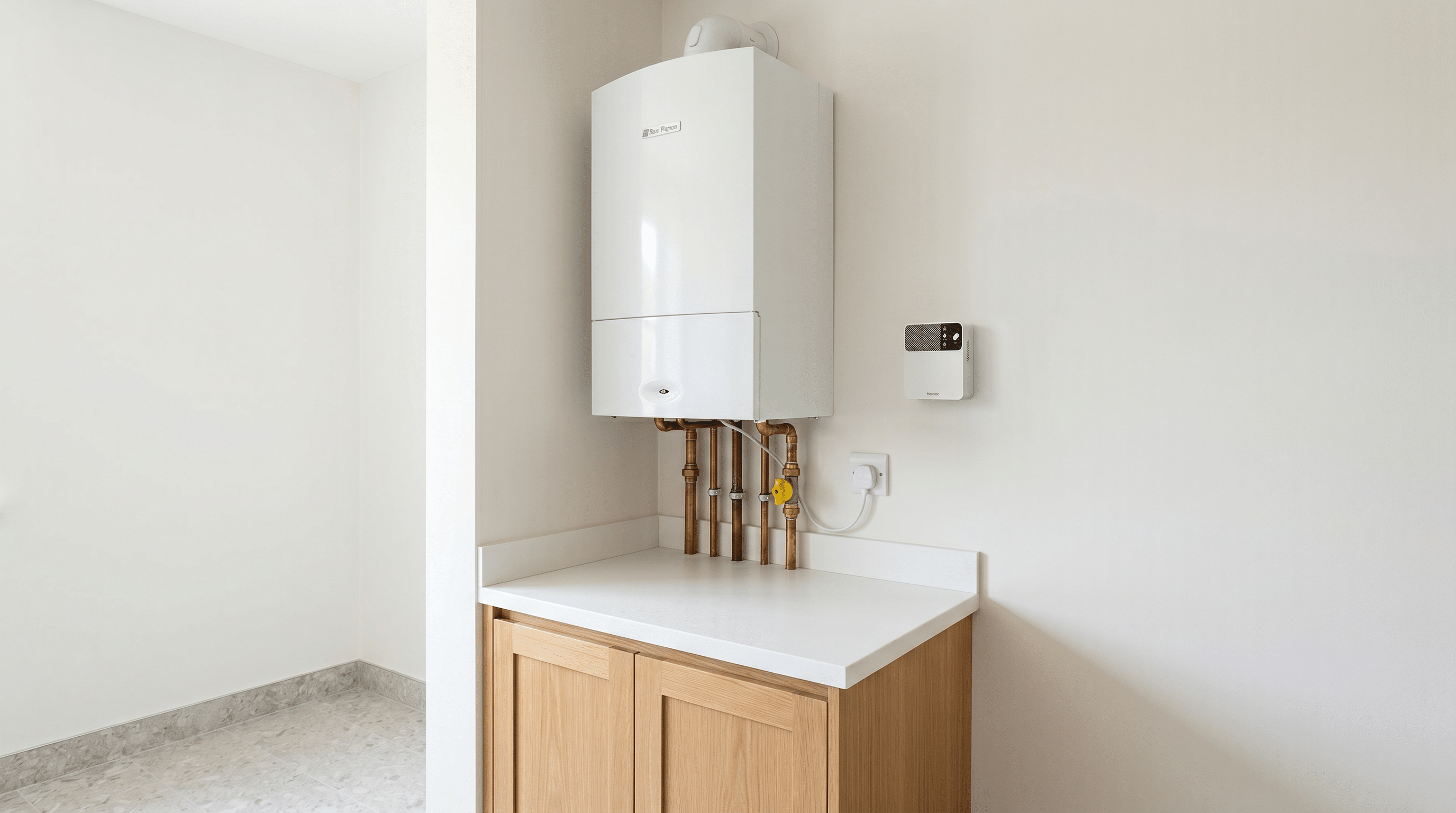
When a fuel-gas-burning appliance is located inside a dwelling, the natural gas alarm must generally be installed in the same room. It must be positioned at least three feet and no more than ten feet horizontally from the appliance.
The alarm may be installed on the ceiling or on a wall. When wall-mounted, it must be no more than 12 inches below the ceiling. Different placement may be required when the room does not allow the standard distance or when the manufacturer’s instructions or NFPA 715 specify another location.
Natural gas alarms may also be required in public or private areas containing gas appliances, including rooms with gas stoves, dryers, water heaters, boilers, or heating equipment. Owners should therefore assess the entire property rather than limiting their review to apartment kitchens.
Battery-powered and plug-in natural gas alarms may be installed by an owner, maintenance employee, or occupant. Other electrically powered systems generally require a New York City licensed electrical contractor and the necessary permits.
Can non-compliance lead to penalties?
Local Law 157 may be enforced by HPD, DOB, FDNY, and the Department of Health and Mental Hygiene. Failure to install, maintain, replace, or document required gas alarms may result in violations and potential civil penalties under the applicable housing and building codes. The precise enforcement outcome can depend on the property, the type of violation, and whether the condition is corrected within the required period.
Building owners should therefore avoid waiting until the final weeks of 2026. Large residential portfolios may require apartment surveys, resident notices, installation scheduling, product tracking, and follow-up visits.
Choosing a Natural Gas Alarm for Local Law 157
The chosen gas detector should be designed for residential natural gas detection and meet the applicable listing and labeling requirements. Owners should also consider the power source, expected service life, maintenance requirements, audible warning level, installation method, and ability to track multiple devices.
Nexelec’s VIGAS natural gas alarm is ETL Listed by Intertek and conforms to UL 1484. It detects natural gas, primarily methane, and provides audible and visual alerts at 10% of the Lower Explosive Limit. Its sealed lithium battery is designed for a ten-year service life without wiring or routine battery replacement.
For property managers responsible for multiple dwellings, VIGAS also includes QR-based identification that supports installation and maintenance tracking. Owners can review the complete NYC Local Law 157 requirements and learn more about selecting a natural gas alarm for residential buildings before organizing their deployment.
How can owners determine whether their building is covered?
Building owners should begin by confirming the legal classification of the property and checking whether natural gas piping or natural gas service is present. The number of dwelling units, the type of occupancy and the location of gas-burning appliances can all affect the compliance strategy.
For multiple dwellings, a building-wide survey can help identify the apartments, common areas and equipment rooms that may require natural gas alarms. This assessment also makes it easier to estimate the number of gas detectors required and organize installation before the January 1, 2027 deadline.
How should building owners prepare for compliance?
Owners and property managers should avoid treating Local Law 157 as a last-minute installation project. Preparing early allows time to select approved natural gas detectors, notify occupants, arrange access to dwelling units and maintain accurate compliance records.
For large residential buildings or property portfolios, each gas alarm should be linked to a specific apartment or installation location. Recording the product reference, installation date and expected replacement date can simplify future maintenance and help demonstrate compliance with Local Law 157.