
On October 13, 2026, the New York City Department of Buildings (DOB) published new guidance on natural gas detectors for property owners, and Nexelec’s VIGAS appears in it by name. The announcement lands less than three months before the January 1, 2027 deadline, so it is a useful reference for anyone still deciding which alarm to buy. This article explains what the city said, what it does not say, and what to verify before you equip a property.


Published on 22 October 2026
VIGAS Named in NYC DOB’s Natural Gas Detector Guidance Ahead of 2027 Deadline
In this article:
What Did NYC DOB Announce on October 13?
The Department of Buildings issued a press release titled Natural Gas Detectors Improve Public Safety in NYC Homes. Its core message is direct: owners of covered residential buildings must provide and install code-compliant natural gas alarms in every dwelling unit by January 1, 2027. The requirement comes from Local Law 102 of 2025, which sets that date for the original Local Law 157 requirement.
The release describes who is covered: residential buildings with gas piping, including apartment buildings, private dwellings such as one- and two-family homes, hotels, motels, lodging and rooming houses, and single room occupancy buildings. Alarms go near the gas appliances in each unit, and owners may choose hard-wired, plug-in or battery-powered models.
The phrase “code-compliant” points to the city’s rule, 1 RCNY §908-02. Under that rule, a natural gas alarm follows the NFPA 715 standard, carries the manufacturer’s name, and is listed and labeled under UL 1484 or UL 2075, depending on the type of device. The rule then sets conditions for where each alarm goes in the dwelling.
Three local texts work together here. Local Law 157 of 2016 first introduced the obligation for natural gas detecting devices in New York City homes, and Local Law 102 of 2025 set the final date. The DOB rule defines the technical requirements for the devices and their placement, while the HPD rule defines the notice and record requirements. Understanding which text answers which question saves a lot of time during a compliance review.
To help owners get started, DOB lists battery-powered models that are listed to UL 1484 and meet the law. Five manufacturers appear: Aware Buildings (NG-101), DeNova (DD623NCV, DD620NV and ML-310ES), Heiman (HM-733NS), Universal Security Instruments (USI/NG/10YR) and Nexelec, with the VIGAS model linked to its product page.
Two details matter when you read that list. First, the city states that it does not endorse specific manufacturers, models or types. Second, the list is partial, and other compliant products may exist. Being named by DOB therefore means VIGAS is cited as an example of a battery-powered, UL 1484 listed alarm. It does not mean the city has approved it above other options.
The release also covers support and enforcement. DOB and National Grid will hand out a limited number of free detectors to small residential property owners at outreach events in all five boroughs, on a first come, first served basis. Starting in 2027, HPD code enforcement staff will inspect for the alarms. The safety message for occupants is simple: if an alarm sounds or you smell gas, leave immediately, then call 911 from a safe location. The gas utility, National Grid or Con Edison depending on the service area, is the next call.
What Does This Mean for NYC Property Owners?
The most practical effect is clarity. Earlier this year, DOB confirmed that it had identified at least four manufacturers of qualifying battery-powered alarms, which closed the door on a possible extension. The October list goes further and shows landlords real models, from several makers, that they can research today. Choosing an alarm no longer means guessing whether suitable products exist.
The calendar is the second effect. With no extension and inspections announced for 2027, the period between now and January 1 is the window to survey units, order devices, install them and document the work. A property with dozens of dwellings cannot be equipped in a single afternoon, and each unit needs its own check of where the gas appliances are.
The third effect is a matter of responsibility. The guidance helps with product selection, but it does not replace your own verification. You remain responsible for confirming that the alarm you buy is properly listed, that it is installed in the right place, and that the required notices and records are in place. Our Local Law 157 compliance checklist walks through those steps in order.
Costs, boards and managing agents
For co-op and condominium boards, the first question is usually who pays. Under the city’s rule, the owner or board carries the cost of buying and installing the alarms, and also the cost of replacing a device that is stolen, removed or found inoperable. A narrower carve-out lets the owner or board charge part of the cost to a unit owner, shareholder or tenant who is responsible for the damage. Boards that settle this allocation before the installation starts avoid disputes later, especially in a building with a mix of owned and rented units.
Occupant information and records
The law does not stop at the device. HPD rules require owners of covered dwellings to post an HPD-approved notice in a common area and to give written information to at least one adult occupant in each unit. That information covers gas leak and carbon monoxide risks, testing and maintenance of the alarm, what to do when it sounds, its useful life and the duty to replace it. A gas leak procedure notice goes to the occupant with the first lease or renewal: leave the building, call 911, then call the gas provider.
The same rules ask owners to keep records on the premises or at the managing agent’s office. These records include the date the notice was posted, the manufacturer’s suggested useful life for each alarm, and proof that the devices meet the applicable laws. They must be available to HPD, DOB, FDNY and the health department. The rule does not name a retention period, so keeping them as long as the alarms remain in service is a sensible default.
Small owners have one more option. If you manage a one- or two-family home or a small property, the free detector events organized by DOB and National Grid may cover part of your needs, subject to availability. Larger portfolios and managing agents will generally need to purchase and schedule their own deployment.
What Should You Check Before Choosing a Natural Gas Alarm?
Certification
DOB states that detectors must be listed and labeled to UL 1484 or UL 2075, and it advises owners to confirm that a product is properly listed. Look for the listing mark on the packaging and the datasheet, and keep a copy. A listing from an accredited laboratory other than UL can be equally valid when it references the same standard, which we explain in our article on ETL listed vs UL listed alarms.
Power source
The rule allows hard-wired, plug-in and battery-powered alarms. Hard-wired units require a licensed electrical contractor and permits, while battery and plug-in alarms can generally be installed by maintenance staff or occupants. The rule text also attaches conditions to the power source that depend on the property, so confirm the requirements in 1 RCNY §908-02. For a battery model, check the stated service life, because the owner is responsible for replacement when a device reaches the end of that life.
Building and dwelling
Coverage depends on gas piping, building type and the location of the fuel gas appliances. Private dwellings, Class A multiple dwellings and Class B multiple dwellings are all covered when they have gas piping or service. A unit with no gas appliance and no gas service generally falls outside the requirement, while a unit with a stove in the kitchen and a water heater in a utility room needs more than one alarm. A unit-by-unit survey is the only reliable way to count.
Detecting systems for public areas
Class B buildings have an alternative to individual alarms: a line-operated, zoned detecting system designed to NFPA 715 by a registered design professional for the public corridors and public spaces. A zoned system is a different category of product from a stand-alone alarm. It runs on the electrical power of the property, covers shared areas rather than individual dwellings, and requires engineering. If you consider that route, ask the designer how the system will be monitored, how power is maintained and who handles maintenance. Class A properties and private dwellings still need devices in each dwelling.
Installation conditions
Where a gas appliance sits inside a dwelling, the alarm generally goes in the same room, between 3 and 10 feet from the appliance horizontally, on the ceiling or on a wall no more than 12 inches below it. Exceptions apply when the 3-foot minimum cannot be met or when the manufacturer’s instructions or NFPA 715 call for a different location. Natural gas tends to rise, which is consistent with placing a detector at or near the ceiling, and the same logic explains why the location of the fuel gas piping and appliances drives the survey. Before you buy, check the operating temperature and humidity range of the device and confirm that it suits the rooms where it will be mounted.
Replacement and maintenance
An alarm is not a one-time purchase. Under the HPD rule, if a device was missing or inoperable when a new occupant moved in, the owner must provide a working one. If a device proves defective within one year of installation, the owner must replace it within 30 calendar days of written notice. Follow the manufacturer’s testing instructions, and ask whether the status of each device can be monitored across all units, since a silent alarm that nobody checks is a compliance gap waiting to happen.
How Does VIGAS Fit Into a Multifamily Deployment?
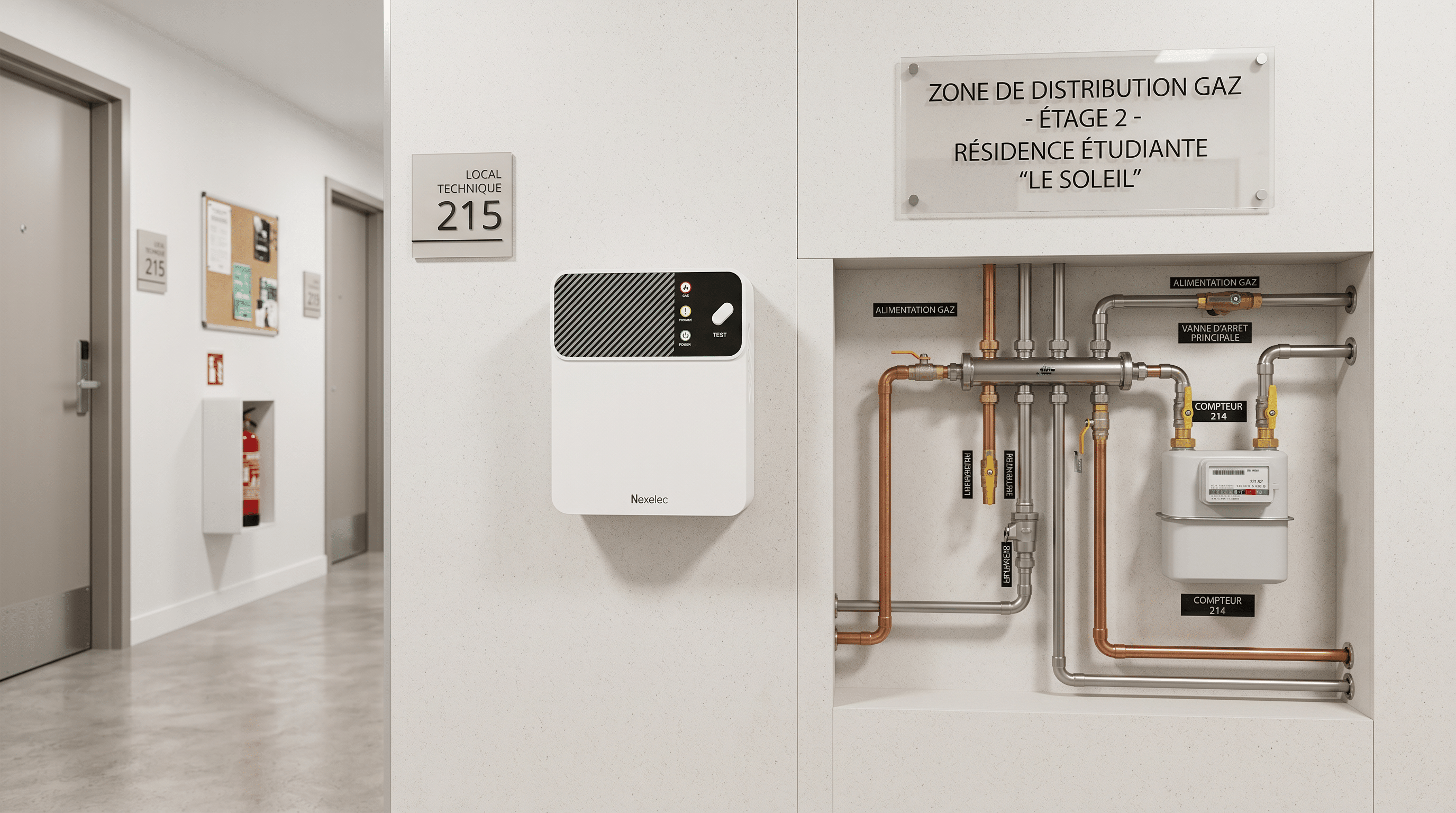
VIGAS is a battery-powered natural gas alarm designed for indoor residential use. It is ETL Listed by Intertek and conforms to UL 1484. It relies on a MEMS semiconductor sensor to detect natural gas, mainly methane, and it sounds an 85 dB audible alarm, measured at 10 feet, with three-color LED status indicators and an integrated Test/Hush button. The alarm threshold is 10% of the lower explosive limit, the level UL 1484 uses for residential fuel gas alarms.
It is a natural gas alarm only, so it does not detect carbon monoxide, smoke or propane. A property that burns propane needs a different solution, and every dwelling still needs its own smoke and CO alarms. VIGAS complements those devices, it does not replace them.
For a multifamily property, the main advantage is the absence of wiring. VIGAS needs no outlet and no electrical work. It mounts on the wall with the screws and anchors supplied in the box, which means a maintenance team can install it unit after unit without scheduling an electrician. Its sealed lithium battery is designed for a ten-year service life, with a low-battery alert, and the whole alarm is replaced at the end of that life. Nexelec offers a two-year limited warranty, and the ten-year figure describes service life, not warranty coverage.
Documentation is the second benefit. Each VIGAS carries a QR code that identifies the device during installation or service. Scanned into the NAVIXIS platform, it lets a property team track where each alarm is installed, when it went in and what maintenance it received. That helps you build the installation record that HPD expects landlords to keep, and it gives you a clear answer if an inspector asks about a specific unit.
Mixed portfolios and public areas
Many portfolios are not uniform. A Class A apartment house, a Class B rooming house and a row of private dwellings can sit in the same management contract, and the requirements are not identical. VIGAS is a unit-level device, so it fits dwellings, while a Class B property that opts for the public-area system needs a design professional and a system installer. Treat each property as its own project, then group the dwellings by type to simplify purchasing.
A practical rollout in five moves
A multifamily deployment goes more smoothly when it follows a fixed order. Start with the survey: walk each dwelling, note every room with a gas appliance, and record the building class. Then order the devices, with a small allowance for units you could not enter during the survey. Install by floor or by line so that nothing is missed, and scan each QR code as the alarm goes up. Next, give each occupant the written information and post the common-area notice. Finally, file the records where HPD can ask for them.
If you are planning that rollout, you can request a quote for VIGAS sized to your dwellings, or contact Nexelec’s US distributor, 123 Security Products, to order. Have the number of units, the rooms with gas appliances and the building class ready, and the quote will match your actual needs. For a detailed walkthrough of placement and installation records, read our guide to VIGAS and Local Law 157.