
A gas leak rarely announces itself the way a fire does. There’s no smoke, no obvious warning sign — just a slow buildup of an invisible gas that can reach dangerous levels before anyone in the room notices anything unusual. That’s the exact problem a natural gas detector is built to solve, and understanding how it actually senses gas makes it much easier to judge which device is worth trusting. The short version is that a detector reacts to the gas itself, at a chemical or physical level, long before a person would smell or feel anything wrong — but the details of how that reaction turns into a loud alarm vary quite a bit depending on the technology inside.


Published on 17 September 2026
How does a Natural Gas Detector work?
In this article:
What a Gas Detector is actually measuring
Natural gas is almost entirely methane, and in its raw form it’s colorless and odorless. Utility companies add a sulfur-based odorant precisely so a leak can be smelled, but that safeguard has limits: a person’s sense of smell can be dulled by sleep, illness, or simply a large or well-ventilated space. A detector removes that uncertainty by measuring the gas itself, molecule by molecule, rather than waiting for a human nose to catch a scent. That’s also why small leaks are treated just as seriously as a sudden, large one: a detector’s job is to detect a rising concentration long before it becomes a safety problem, not just to catch an obvious one. A home or building without one is relying entirely on smell and luck to stay safe.
The lower explosive limit and why it matters
Every combustible gas has a Lower Explosive Limit, or LEL — the minimum concentration in air at which it can ignite. Below that threshold, there isn’t enough gas present to sustain a flame even if a spark occurs. Detectors are calibrated against this reference point, and their readings are usually expressed as a percentage of the LEL rather than as a raw concentration. Most residential units will sound their alarm well before the true explosive threshold is reached, giving occupants a meaningful safety margin rather than a last-second warning.
Raw natural gas straight from the ground isn’t quite as simple as the gas that reaches a home. Before it’s distributed, processors remove impurities such as hydrogen sulfide and separate out excess carbon dioxide, leaving mostly methane behind. Only after that processing does a utility add the sulfur-based odorant that gives finished natural gas its familiar smell.
Not every gas appliance carries the same leak risk, but the gas itself behaves identically no matter which appliance it comes from. A furnace, a water heater, a stove, and a dryer can all be fed by the same underlying natural gas supply, so an issue with any one of them introduces the same combustible gas into the surrounding air. That’s part of why homes with several natural gas appliances often end up installing more than one detector rather than relying on a single unit for the whole space: multiple detectors, each placed near its own appliance, catch a problem far faster than one unit expected to cover an entire home.
In most homes, a natural gas detector ends up in one of a handful of predictable spots: the kitchen near the stove, a basement or utility room housing the furnace and water heater, or a garage if gas equipment is kept there. Wherever gas equipment sits, that’s where detection needs to happen, since a leak rarely travels far from its source before it’s caught. Recognizing the presence of a gas appliance in a room is usually the simplest way to decide whether a detector belongs there.
Three ways a sensor can detect gas
Not every detector senses gas the same way. Three sensor technologies dominate the market, and each has a different physical principle behind it.
Catalytic Sensors
A catalytic sensor, sometimes called a pellistor, works through a small pair of coils wound from platinum wire, one of them coated with a palladium-based catalyst. Wired into a Wheatstone bridge circuit, the coated coil heats up and burns off any combustible gas that reaches it, while the uncoated coil acts as a reference. That temperature difference shifts the electrical balance between the two, and the shift is read as a gas concentration. Catalytic sensors need oxygen to function, and because the catalyst itself can be degraded by silicone, sulfur compounds, or lead vapor, they typically call for more frequent calibration than the other technologies described here.
Semiconductor Sensors
A semiconductor sensor relies on a metal oxide surface, often tin dioxide, that is heated to a few hundred degrees. When gas molecules land on that surface, they react with it and change its electrical resistance, and the size of that change is proportional to how much gas is present. This design tends to be compact, inexpensive to produce, and quick to respond, which is why it shows up widely in consumer safety devices — VIGAS, a natural gas alarm made by Nexelec, uses a MEMS semiconductor sensor built on this same principle. Because a MEMS-based design draws relatively little power compared with the constantly heated coil in that earlier approach, it’s also better suited to a battery-powered product that needs to keep running for years rather than staying plugged into a wall outlet.
Infrared Sensors
Infrared, or NDIR, sensors take a different approach entirely: they shine two wavelengths of infrared light through the air, one that methane absorbs and one that serves as an unaffected reference. Comparing the two tells the system how much gas is in the path of the beam. Because this method doesn’t depend on a chemical reaction, it doesn’t require oxygen to work, which makes it useful in pipeline monitoring and other industrial settings where that approach would struggle. It has become the more common choice for fixed, large-scale detection systems, even though it costs more to manufacture than the other two detection methods.
From a resistance change to a loud alarm
Whichever detection method is used, the raw signal it produces — a shift in resistance, a change in temperature, a drop in infrared light — is only the first step. A small onboard circuit continuously compares that signal against a calibrated baseline. Once the reading crosses a preset percentage of the LEL, the circuit triggers the alarm: a loud audible tone, usually paired with a flashing visual signal for anyone who is hard of hearing. Everything between the initial detection and the alarm sounding happens automatically and within seconds, with no action required from the person in the room.
Once an alarm sounds, the appropriate response is straightforward: open windows and doors to ventilate the space, avoid anything that could create a spark such as light switches or open flames, and leave the area if the gas smell or alarm persists. Utility companies generally recommend shutting off the gas supply at the meter only once everyone is safely outside, since handling a valve inside a room already filled with gas adds unnecessary risk. A detector’s alarm is the starting signal for that sequence, not the entire safety plan on its own — it works alongside basic precautions that any household with natural gas service should already know.
Why placement changes everything
A detector can be flawless and still fail to do its job if it’s mounted in the wrong spot. Natural gas is lighter than air, so it rises and collects near the ceiling rather than sinking toward the floor. That’s why placement guidance for these devices, including the standard published by the National Fire Protection Association, calls for mounting on or near the ceiling, typically within several feet of the gas-burning appliance being monitored. A unit installed near an outlet or at floor height would sit in exactly the wrong layer of air, missing a leak until it had spread throughout the whole room. Leaks also behave differently across environments: a small, enclosed closet reaches a hazardous concentration far faster than the same amount in a large, open room, which is another reason placement guidance treats detection as specific to each space rather than uniform across different environments.
Fixed, portable, and everything between
The three detection approaches aren’t spread evenly across every setting. A single-family home or apartment almost always uses a fixed, wall- or ceiling-mounted unit that stays in place permanently, quietly running in the background for years. Industrial sites tend to layer several approaches at once: fixed infrared or catalytic sensors wired into a building-wide monitoring system for continuous coverage, plus portable, handheld detectors that a technician carries into a specific area — a utility vault, a mechanical room, a section of pipeline — to get an immediate, on-the-spot reading before starting work there. Portable units built for natural gas typically rely on the same catalytic or infrared principles described above, just packaged for mobility and paired with a display that shows a live percentage of the LEL rather than a simple pass or fail alarm. That distinction matters for anyone comparing products: a device built for continuous, unattended residential use is optimized differently than one meant to be walked into a suspected leak and read on the spot.
In industrial environments — refineries, treatment plants, or confined utility spaces — several hazardous gases can be present at once, and a facility often has to monitor for more than just methane. In areas without adequate ventilation, combustible gases can build toward a dangerous concentration far faster than in an open, well-aired room. Across different industries, that combination of continuous monitoring, reliable airflow, and properly placed detectors is treated as one integrated safety system rather than isolated pieces of equipment. Well-ventilated areas with active airflow reduce that risk considerably, which is why many facilities across gas-handling industries pair detection with mechanical ventilation to keep a work environment safe, rather than relying on natural airflow alone.
Industrial teams also lean on regular calibration schedules to keep both catalytic and infrared instruments accurate across the specific areas they cover, since a sensor drifting out of range in a hazardous or combustible environment carries far higher stakes than a similar drift in a home. Ventilation engineers and safety officers in gas-handling industries typically coordinate calibration with routine maintenance shutdowns, checking each fixed and portable unit against a known reference gas before returning it to service. That level of oversight is one more reason industrial monitoring looks so different from a single home alarm quietly running in the background.
Natural Gas Detectors vs. Carbon Monoxide Detectors
The two are often confused, but they’re built to catch entirely different hazards. Natural gas detectors watch for methane, an explosion risk before it’s a breathing risk. Carbon monoxide detectors watch for CO, a byproduct of incomplete combustion that’s toxic to breathe but not something that will ignite the way methane can. Carbon monoxide also mixes fairly evenly with air rather than rising sharply, so CO alarms are generally installed at breathing height instead of near the ceiling. Detection differs too: CO detectors typically rely on an electrochemical cell tuned to that specific gas, while a device built for methane needs a catalytic, semiconductor, or infrared sensor instead. A detector built for one hazard won’t reliably catch the other, which is why homes with both gas appliances and combustion sources are often advised to have separate, purpose-built devices for each. Some combination products do exist that house detection for both gases in a single enclosure, but even there the two hazards are still being measured by two distinct sensing elements working independently — the shared housing is a convenience, not a shortcut around the underlying physics.
Combination alarms that watch for both gases are increasingly common on store shelves, and they work by pairing two independent sensing elements behind one faceplate: typically a catalytic or semiconductor element for methane and an electrochemical cell for carbon monoxide. Because methane and carbon monoxide behave so differently in air, a safe design still treats each gas’s levels separately rather than averaging them into a single reading. Buyers comparing combination units to two standalone alarms should check whether both hazards are rated to the same certification standard, since one strong rating doesn’t guarantee the other.
What reliable detection looks like in practice
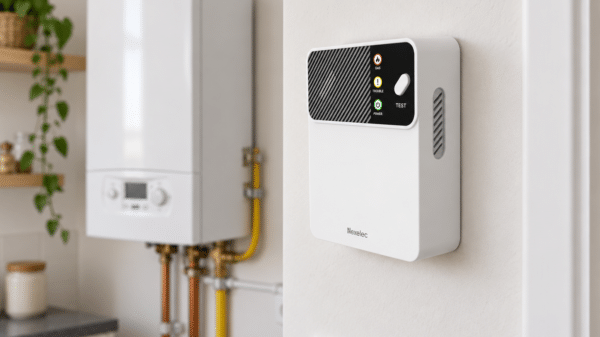
VIGAS, Nexelec’s battery-powered natural gas alarm, is a useful example of how these principles come together in a finished product. It’s ETL Listed by Intertek and conforms to UL 1484, the safety standard that governs residential natural gas detectors in the United States. Its MEMS semiconductor sensor is calibrated to sound at 10 percent of the Lower Explosive Limit, well ahead of any genuinely hazardous concentration, and the alarm itself combines an 85-decibel signal at ten feet with a visual indicator. Because it runs on a sealed lithium battery rated for a ten-year lifespan, there’s no wiring and no routine battery swap for an occupant to forget. For property managers tracking multiple units, VIGAS also carries a QR-based identifier that ties into Nexelec’s NAVIXIS platform, making it straightforward to confirm which detector is installed where.
Choosing between detection technologies often comes down to where the gas needs to be watched. A homeowner mainly needs to detect a leak before it turns hazardous, so a single fixed unit near each gas appliance covers that job well. An industrial site with pressurized gas lines, storage tanks, and multiple potential leak points has a harder problem: detecting gas across a much larger area, often with a mix of fixed and portable equipment working together. In both settings, though, the goal doesn’t change — sense the gas as early as possible, and give whoever is nearby enough warning to act. A properly functioning detector needs to detect gas reliably across the environments it’s likely to encounter — a warm kitchen, a cold garage, a humid basement — without missing a real one or sounding false alarms. Portable and industrial units go through similar testing, since detecting gas in a refinery follows the same basic physics as detecting it in a kitchen, even if the surrounding environments and equipment look completely different.
The installation guide that comes with a detector typically specifies exact mounting height and distance from the appliance, and following it closely matters more than any general rule of thumb. Facilities that store compressed or liquefied gas add another layer of complexity, since larger storage volumes raise both the sensitivity and placement requirements for detection compared with a typical home.
Comparing products before buying is worth the extra time, since not every option on a store shelf is designed with the same rigor. A reliable product will state its certification, sensor technology, and expected service life clearly on the packaging or product guide rather than leaving a buyer to guess. Presence of a visible test button and a clear indicator light are small details, but their presence usually signals a manufacturer that has thought through real-world use, not just laboratory performance.
Certifications worth checking before you buy
A device’s technology only matters if it has been independently verified to perform the way its manufacturer claims. In the United States, that verification generally comes through UL 1484, the listing specific to natural gas alarms, or the related UL 2075 listing for broader combustible-gas detection. These listings come from accredited testing labs and confirm that a device has been evaluated against a consistent set of performance and safety criteria — sensitivity, alarm volume, response time — before it reaches the market. Installation guidance is a separate question from certification, and it usually points back to a standard such as NFPA 715, the National Fire Protection Association’s reference for where and how these devices should be mounted. Some cities have gone further and written detector requirements directly into their building codes — New York City’s Local Law 157 is one example — but even outside any legal mandate, a UL-listed device installed according to its documented placement guidance is the baseline worth looking for.
What can set off a false alarm
No detection method is perfectly selective, and understanding why a detector occasionally alarms without an actual leak helps explain why detector choice and placement both matter. Semiconductor sensors, in particular, can respond to other volatile compounds in the air — certain cleaning products, aerosols, or solvents — because the underlying chemical reaction on the metal oxide surface isn’t limited to methane alone. Humidity and temperature swings can shift a device’s baseline reading as well, which is one reason manufacturers specify an operating temperature and humidity range for reliable performance. A well-designed detector accounts for this with calibration and filtering built into its circuitry, but it’s also why placement near a stove or a bathroom vent, where cooking fumes or steam are common, isn’t ideal even though those are exactly the rooms a gas appliance sits in. Following the manufacturer’s placement guidance is as much about avoiding false alarms as it is about catching real ones.
Keeping a detector accurate over its lifetime
Underlying technology also shapes how much upkeep a device needs. Catalytic sensors tend to drift over time and require periodic calibration against a known gas concentration to stay accurate, which is standard practice in industrial settings with dedicated safety staff. Semiconductor sensors used in consumer alarms are generally designed to need far less intervention, but the detector’s battery and that component’s own service life still matter. A unit like VIGAS, built around a sealed battery rated for a decade, sidesteps most of that maintenance burden by design rather than asking an occupant to remember a testing schedule. That said, sensor calibration and a working alarm circuit are two different things, and most manufacturers still recommend using the device’s test button occasionally to confirm the alarm itself — the speaker, the visual indicator, the circuit board — is functioning, separate from whether the underlying technology is still tracking gas concentration accurately. Whatever the detection method, the underlying idea stays the same: a detector is only useful for as long as it keeps sensing accurately, so its calibration and service life are worth understanding at the time of purchase, not after an alarm has already gone quiet.