
Local Law 97 is one of the most important climate and energy laws in New York City. Adopted by the New York City Council, this regulation aims to significantly reduce greenhouse gas emissions from NYC buildings. Today, buildings generate nearly 70% of carbon emissions in New York City, which makes the building sector central to the city’s climate strategy.
To address this issue, the law introduces strict emissions limits for large buildings and requires property owners to track energy consumption and carbon emissions. Each year, covered buildings must submit an emissions report to the NYC Department of Buildings (DOB) showing whether they comply with the established limits.
For building owners, understanding Local Law 97 compliance requirements is now essential. Thousands of NYC buildings must reduce their GHG emissions, improve energy efficiency, and implement strategies to meet the city’s long-term climate goals.



Published on 4 March 2026
Local law 97: NYC building emissions limits and compliance guide
In this article:
Local law 97 emissions reporting and energy monitoring in NYC
Under Local Law 97, large NYC buildings must respect strict carbon emissions limits defined by the New York City Council. The regulation targets greenhouse gas emissions produced by buildings and requires building owners to monitor energy consumption, calculate carbon emissions, and submit an annual emissions report.
Each year, covered buildings must provide a detailed public report of their building emissions to the NYC Department of Buildings (DOB). These reports allow the city to monitor NYC building emissions and verify that properties remain below the emissions limits established by the law.
The first reporting deadlines started in February, and building owners must now track energy performance, carbon emissions, and GHG emissions more closely. This reporting framework complements other regulations such as the NYC Benchmarking Law, which already requires buildings to track energy usage and emissions data.
By improving energy efficiency, reducing reliance on natural gas, and implementing energy monitoring systems, building owners can reduce building emissions and ensure full Local Law 97 compliance.
Local law 97 emissions limits for NYC buildings
The main objective of Local Law 97 is to reduce greenhouse gas emissions from buildings in New York City. The regulation sets strict carbon emissions limits based on a building’s gross floor area and occupancy type.
Buildings larger than 25,000 square feet are classified as covered buildings. These buildings must comply with defined emissions limits that become stricter over time. The first compliance period began in 2024, and future phases will further reduce allowable building emissions.
This law is part of a broader climate policy framework supported by New York State and aligned with international climate commitments such as the Paris climate agreement.
Organizations like the Urban Green Council have helped develop guidance for property managers navigating this energy efficiency legislation.
By forcing large properties to reduce their carbon emissions, the regulation aims to accelerate the transition toward renewable energy and cleaner building systems.
NYC buildings covered by Local law 97 emissions rules
Local Law 97 applies to many NYC buildings with a gross floor area exceeding 25,000 square feet. These properties include residential towers, office buildings, hotels, and large mixed-use developments.
Each property is identified using its BBL (borough, block, and lot) number, allowing the NYC Department of Buildings to track building emissions and compliance data.
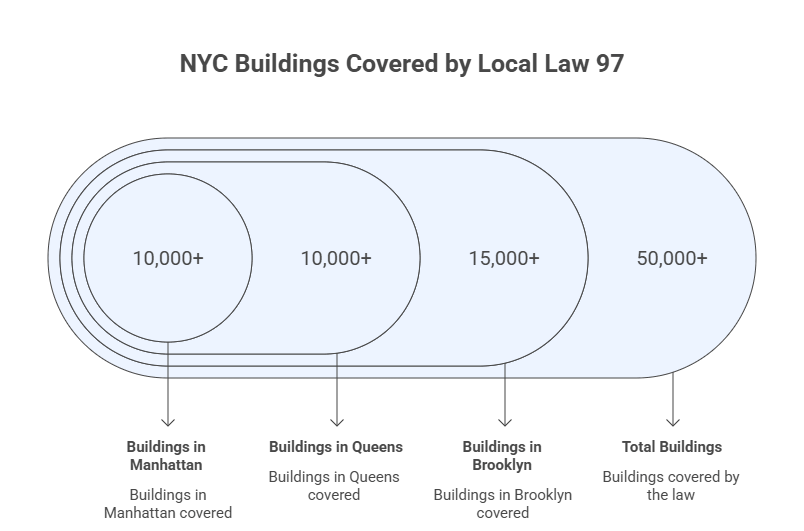
Across New York City, more than 50,000 buildings fall under the regulation. Many of these properties are located in Brooklyn, Queens, and Manhattan.
Some buildings, including certain affordable housing properties, may receive adjusted requirements depending on their ownership structure or regulatory status with HPD.
However, the majority of large buildings must comply with the regulation and report their annual greenhouse gas emissions.
These reports help the city monitor NYC building emissions and evaluate progress toward long-term climate change targets.
Local law 97 compliance requirements for building owners
To achieve Local Law 97 compliance, building owners must calculate and report their greenhouse gas emissions every year.
These emissions are determined based on energy consumption, including electricity, heating fuels, and natural gas usage.
Property managers must submit an annual emissions report to the NYC Department of Buildings (DOB). This report must be verified by a Registered Design Professional (RDP).
Key compliance requirements include:
- monitoring energy consumption across the building
- calculating carbon emissions and GHG emissions
- submitting an annual emissions report
- maintaining documentation for inspections and audits
Many properties must also complete energy audits and retro commissioning projects.
These audits often lead to improvements such as:
- lighting upgrades and advanced metering
- HVAC system optimization
- improved building insulation
- smarter energy monitoring systems
These improvements help reduce building emissions while improving overall energy efficiency.
Penalties for exceeding NYC building emissions limits
Buildings that exceed the emissions limits defined by Local Law 97 must pay financial penalties.
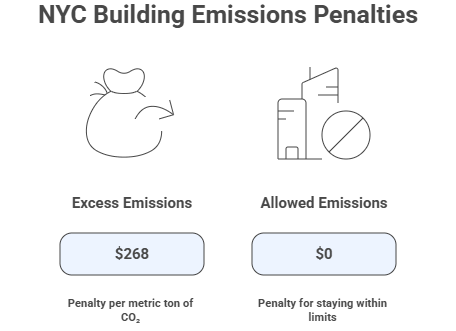
The penalty is calculated based on the amount of excess carbon emissions produced by the building. Currently, the fine is approximately $268 per metric ton of CO₂ equivalent above the allowed limit.
For large properties with inefficient energy systems, these penalties can reach hundreds of thousands of dollars per year.
The NYC Department of Buildings is responsible for enforcing the law and reviewing compliance reports.
Buildings that fail to submit their annual emissions report may also face additional penalties.
Because these fines can be significant, many property owners are investing in energy efficiency upgrades, carbon monitoring tools, and new building technologies.
Reducing energy consumption and emissions is often more cost-effective than paying repeated penalties.
Strategies and tools to achieve Local law 97 compliance
Meeting the requirements of Local Law 97 requires a combination of technical upgrades, energy management, and emissions monitoring.
One of the most effective strategies is improving energy efficiency across building systems. Energy audits often reveal opportunities to reduce energy consumption and carbon emissions.
Common strategies include:
- upgrading heating and cooling systems
- improving insulation and building envelope performance
- installing smart energy monitoring systems
- reducing reliance on natural gas heating
- integrating renewable energy solutions
Digital platforms also play an important role in managing building emissions data and preparing compliance reports.
Solutions such as Navixis help property owners monitor energy consumption, track GHG emissions, and generate the reports required for Local Law 97 compliance.
By centralizing building data and providing performance insights, platforms like Navixis help building owners navigate the complexity of NYC climate regulations and identify opportunities to reduce carbon emissions.
With the right strategy and tools, Local Law 97 compliance becomes an opportunity to modernize buildings, improve energy efficiency, and support New York City’s climate goals.