
Many residents and property teams assume that a carbon monoxide alarm also detects natural gas. It does not.
For property managers, that misunderstanding can create a serious safety gap in apartment buildings, rental homes, mixed-use properties, and residential communities with gas appliances.


Published on 6 July 2026
Natural Gas Alarm vs Carbon Monoxide Alarm: what property managers need to know
In this article:
What does a carbon monoxide alarm detect?
A carbon monoxide alarm detects carbon monoxide, often called CO. CO is a poisonous gas produced when fuels do not burn completely. Fuel-burning appliances such as furnaces, boilers, water heaters, fireplaces, stoves, dryers, and generators can all become possible sources of co if they are damaged, poorly vented, improperly installed, or not maintained correctly. The CPSC describes co as a gas with no smell, color, or taste, and notes that burning fuels such as gas, oil, wood, or coal can produce CO.
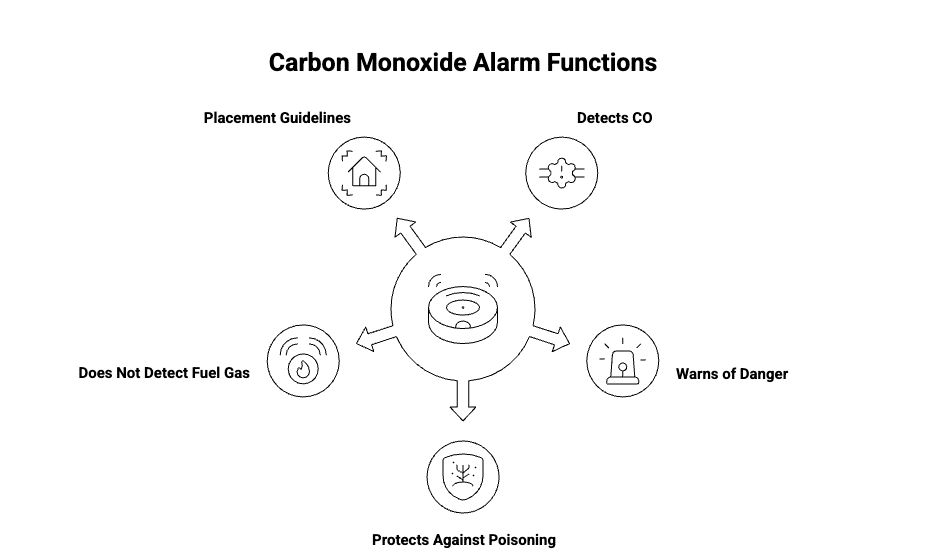
Carbon monoxide alarms are built to monitor the air for CO and sound an audible warning when dangerous conditions may be developing. Their role is not to detect fuel gas before combustion. Their role is to detect carbon monoxide after incomplete combustion has occurred.
This is why a co alarm should never be treated as a natural gas detector. Even if the building has gas appliances, a standard carbon monoxide alarm is not designed to detect natural gas leaks, methane, propane, or liquefied petroleum gas. It protects against carbon monoxide poisoning, not against the fire or explosion risk created by leaking fuel gas.
In apartment buildings, carbon monoxide alarms are commonly required near sleeping areas, on different levels of a dwelling, or in locations defined by local building and fire codes. The CPSC recommends CO alarms on each level of the home and outside sleeping areas. Property managers should always check the applicable code, manufacturer’s instructions, and local authority having jurisdiction before finalizing placement.
What does a natural gas alarm detect?
A natural gas alarm detects fuel gas leaks. In most residential buildings connected to a natural gas supply, the primary gas of concern is methane. In some properties, fuel gas detectors may also be selected for propane or liquefied petroleum gas, depending on the appliances and the fuel source.
Natural gas alarms are designed to detect natural gas before it reaches a dangerous concentration. Their purpose is to provide early warning of a leak from a gas stove, furnace, boiler, water heater, dryer, fireplace, line connection, or other gas appliance. Unlike carbon monoxide, natural gas is not the result of incomplete combustion. It is the fuel itself escaping before it is burned.
This difference changes the entire safety logic. A carbon monoxide alarm responds to a toxic gas created by combustion. A natural gas alarm responds to an unburned fuel gas leak that can create fire, explosion, or evacuation risks. These dangers are different, so the devices used to monitor them must be different as well.
Placement also differs. Natural gas is lighter than air and tends to rise, so natural gas detector placement is not the same as carbon monoxide alarm placement. NFPA 715 was created to provide requirements for the selection, design, application, installation, location, performance, inspection, testing, and maintenance of fuel gas detection and warning equipment in buildings. Property managers should use the manufacturer’s placement guide and the applicable standard or code rather than copying the placement strategy used for smoke alarms or carbon monoxide detectors.
Natural gas alarms may be standalone devices or part of a combination gas carbon monoxide alarm. Some natural gas alarms are standalone devices, while others combine natural gas and carbon monoxide detection. Depending on the building, property managers may compare battery-powered, plug-in, or hardwired options.. When comparing devices, property managers should look beyond the product name and confirm the gases detected, the alarm type, the power source, the listed standard, the expected service life, the available features, and the required maintenance. A reliable natural gas alarm will be selected according to the fuel source, the room layout, and the building’s risk profile.
Why the difference matters in apartment buildings
The difference between carbon monoxide alarms and natural gas alarms matters more in apartment buildings than in many single-family homes because the risk profile is more complex. A multifamily property may contain dozens or hundreds of gas appliances, multiple occupants, shared walls, mechanical rooms, basements, risers, shafts, common corridors, laundry rooms, and tenant-controlled equipment.
A resident may smell gas in one unit while the source is in another. A leak near a stove, boiler, water heater, or gas dryer may affect more than one apartment. A mechanical room issue can create risk for residents, staff, contractors, and neighboring units. In that context, relying only on carbon monoxide alarms can leave a gap because those alarms detect carbon monoxide, not natural gas leaks.
There is also a communication issue. Many residents use the words alarm, detector, gas detector, smoke alarm, and carbon monoxide detector interchangeably. Homeowners often make the same mistake in single-family homes, which shows how common the confusion can be. Property managers should not assume residents understand the difference. Clear move-in instructions, maintenance notices, and safety guides can help explain that smoke alarms detect smoke, carbon monoxide alarms detect CO, and natural gas alarms detect natural gas or other specified fuel gases.
This distinction also affects emergency response. If a carbon monoxide alarm sounds, the concern is possible CO exposure and occupants should follow emergency guidance, leave the area, and contact emergency services or the appropriate utility depending on local instructions. If a natural gas alarm sounds or residents smell gas, the concern is a possible gas leak, ignition risk, and evacuation need. Residents should avoid using switches, flames, or appliances and follow the property’s emergency gas safety procedure.
For property managers, the practical issue is documentation. A strong safety program should account for device type, location, installation date, power source, replacement date, inspection schedule, resident education, and the way each alarm will be maintained over time. It should also distinguish between smoke alarms, carbon monoxide alarms, natural gas alarms, and combination devices. This gives teams a reliable view of what is installed, where protection may be missing, and which devices will need future replacement.
Where natural gas alarms may be needed
Natural gas alarms may be needed in buildings where natural gas appliances or fuel gas systems are present. This can include apartments with gas ranges, units with gas fireplaces, laundry rooms with gas dryers, boiler rooms, mechanical rooms, water heater closets, basements, utility areas, and mixed-use buildings with residential units above or near commercial kitchens.
The exact requirements depend on the jurisdiction. In the United States, property managers should check state law, local code, fire marshal guidance, utility recommendations, and insurance requirements. Maine is one example of a state with a specific fuel gas detector law: its statute requires a fuel gas detector in accordance with the manufacturer’s requirements in each area containing an appliance fueled by propane, natural gas, or liquefied petroleum gas. Maine guidance also makes clear that fuel gas detectors are not the same as carbon monoxide detectors and do not replace CO detection.
Even where natural gas alarms are not explicitly required, they may still be worth evaluating as part of a property’s safety strategy. Property managers should pay particular attention to buildings with older gas infrastructure, frequent resident turnover, hard-to-access mechanical spaces, a history of gas odor complaints, or many in-unit gas appliances. These conditions will not always mean that a specific device is mandatory, but they can help property teams view the building’s dangers more accurately.
Placement should be based on the type of gas and the manufacturer’s instructions. Natural gas detector placement near a ceiling may make sense for methane because natural gas rises, while propane detection may require a different strategy because propane is heavier than air. A device chosen for one gas should not be assumed to work for every fuel gas risk.
In apartment buildings, it is also important to consider who can hear the alarm. An alarm inside a locked mechanical room may not protect residents if no one hears it. A device inside a tenant’s apartment may not alert maintenance staff unless there is a connected notification system. Property managers should consider the difference between local audible alarms, monitored systems, connected devices, and building-wide response procedures. The goal is to create reliable protection that residents, maintenance teams, and managers will understand.

What property managers should check before choosing a device
The first thing to check is what the alarm detects. A carbon monoxide alarm detects carbon monoxide. A natural gas alarm detects natural gas. A combination carbon monoxide natural gas alarm may detect both, but only if the product specifications clearly state that both sensors are included. The label, manual, listing information, and product features matter more than marketing language.
The second point is the applicable standard. For fuel gas alarms, UL 1484 covers electrically operated fuel gas alarms intended for residential occupancies and recreational vehicles, including alarms intended to detect flammable gases such as propane and natural gas. For carbon monoxide alarms, property managers should confirm that the product meets the applicable CO alarm standard required in their jurisdiction.
Power source is another important decision. Battery powered alarms can be easier to install in existing buildings, especially where hardwiring is difficult. Hardwired alarms may be preferred in some new construction or renovation projects, especially when local code requires them or when centralized maintenance is easier. Plug-in alarms may be convenient in certain locations, but property managers must account for resident tampering, outlet availability, and backup battery needs.
Device life should also be checked. Alarms and detectors do not last forever. Sensors age, batteries weaken, and product standards evolve. A property manager should maintain a replacement schedule and avoid relying on old detectors simply because they still appear to power on. This type of tracking will help keep the alarm program reliable over time.
Placement is equally important. Natural gas alarms, carbon monoxide alarms, and smoke alarms are not placed in the same way. A smoke alarm is generally positioned for smoke behavior, a carbon monoxide alarm for CO exposure risk, and a natural gas alarm for fuel gas leak detection. Using the wrong placement can delay detection and reduce protection.
Property managers should also check whether the device is suitable for the specific room. Kitchens, bathrooms, laundry areas, garages, furnace rooms, and mechanical spaces may have different temperature, humidity, airflow, dust, and nuisance alarm conditions. The manufacturer’s guide should explain where the detector can and cannot be installed.
Finally, property teams should think about the resident experience. A reliable alarm program is not only about buying devices. It includes resident instructions, move-in education, maintenance access, testing procedures, emergency contacts, and a clear policy for what residents should do if an alarm sounds or if they smell gas. The best devices will combine the right detection features with clear placement instructions, practical maintenance requirements, and a safety approach that works for property managers, residents, and homeowners alike.